🚚 Free Standard delivery within India when your cart includes any toy — books + toys included. No minimum order value. Express charged separately.

Rs 266
Save 5%
5% OFF
#46 Bestseller
By lifetime units sold on Ziffy Bees · Updated daily
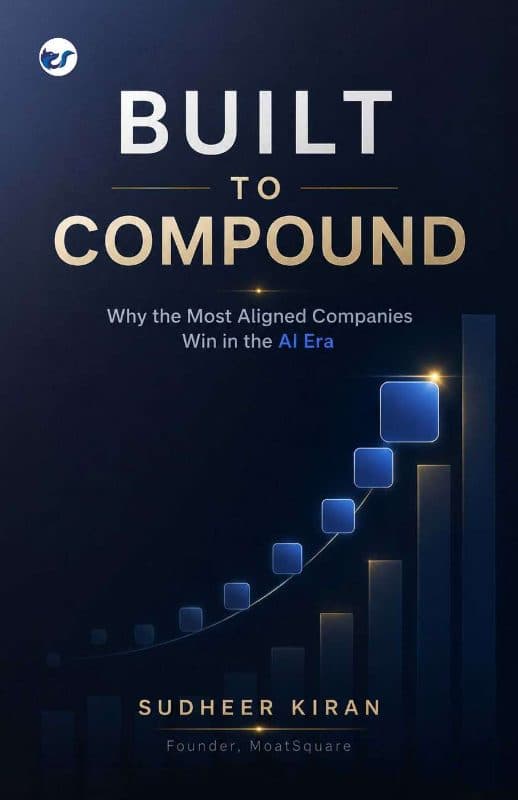
BUILT TO COMPOUND: Why the Most Aligned Companies Win in the AI Era
Category: Non-Fiction · Publisher: Clever Fox Publishing
Author: Sudheer Kiran
Rs 266
MRP Rs 280Save 5%
Format Options
500 units in stock
Product Description
BUILT TO COMPOUND
Why the Most Aligned Companies Win in the AI Era
Author: Sudheer Kiran, Founder, MoatSquare Category: Business Strategy / Marketing Strategy / AI & Future of WorkFormat: ~70,000 words | 16 Chapters | 5 Parts Status: Complete manuscript available
The Pitch:
There is a pattern hiding inside the most durable companies of the past decade. Stripe, Linear, Notion, HubSpot, Figma, Atlassian, Datadog — none of them won by being the loudest. They won by being the most coherent. Their positioning, trust signals, product experience, and market presence didn't just align; they reinforced each other. Every touchpoint built on the last. Over time, the system compounded.
Most companies are doing the opposite without realizing it. They scale campaigns, content, automation, and operational output — and watch their competitive position quietly fragment underneath the movement.
Built to Compound is a strategic thesis about why that gap is widening in the AI era, and what the companies on the right side of it are doing differently.
The Argument
For most of business history, growth was a visibility problem. Whoever had the best distribution, the biggest budget, or the most operational force, won. That model worked because execution itself created leverage.
The AI era disrupts the economics of that model fundamentally. When content becomes infinite, execution becomes commoditized, and operational output becomes easy to automate, the companies that dominate aren't the ones who push harder. They're the ones whose systems are designed to compound.
The central thesis is this: sustainable advantage no longer comes from doing more. It comes from being more aligned.
Alignment — when positioning, customer intelligence, AI integration, operations, trust infrastructure, product experience, and go-to-market execution work together as a reinforcing system — creates what the book calls Strategic Gravity: a natural market pull that reduces dependency on rented attention, constant interruption, and expensive acquisition.
Coherence compounds. Fragmentation doesn't.
This is not a book about marketing tactics. It's not a playbook for AI adoption or a growth-hacks manual. It's a strategic argument about the structural shift that determines which companies build compounding advantage in the next decade — and which ones scale themselves into fragility.
Why Now
Three converging forces make this argument urgent:
AI is compressing execution advantages. The ability to produce content, run campaigns, and automate workflows is no longer a differentiator. Every competitor has access to the same tools. Execution parity means strategic clarity and organizational coherence become the last defensible advantages.
Discoverability is being restructured. AI-powered search and answer engines don't just surface the loudest voices — they surface the most credible, semantically consistent, contextually authoritative ones. Companies that have built coherent trust and semantic authority are winning the AI discoverability race. Companies that have built fragmented content engines are disappearing from it.
The cost of misalignment is rising. In a slower media environment, companies could compensate for strategic fragmentation with advertising spend. In the current environment — where buyers research independently, AI systems mediate discovery, and trust signals are machine-readable — incoherence compounds into market invisibility faster than ever.
The companies that understand this shift now will build structural advantages that are very hard to replicate. Those who don't will keep optimizing activities that are no longer the bottleneck.
Six Frameworks, One Thesis
The book introduces six interconnected frameworks that together constitute the architecture of a compounding company. They are presented sequentially across sixteen chapters and synthesized in the closing section.
1. The Coherence Gap — The diagnostic framework. The measurable distance between what a company claims, what it operationally delivers, and how the market actually interprets it. Closing this gap is the first move.
2. Trust Infrastructure — Trust is no longer soft or qualitative. It now functions as operational infrastructure — influencing acquisition, discoverability, retention, pricing power, and referral simultaneously. It lives on six identifiable surfaces that both buyers and AI systems read.
3. Commercial Control Points — The durable strategic assets that compound independently of platforms and algorithms: semantic authority, customer trust, ecosystem credibility, contextual expertise. Four criteria define a real Control Point: owned, defensible, compounds with usage, and machine-readable.
4. Semantic Authority — In the AI era, visibility is earned not through volume but through recognized expertise that AI systems can read, attribute, and cite. This framework addresses how companies build it deliberately.
5. Designed Growth — The shift from activity-driven growth to system-driven growth. Rather than scaling output, Designed Growth means engineering reinforcement — building a system where each element strengthens the others.
6. Strategic Gravity — The outcome of the other five working together. When a company achieves Strategic Gravity, it attracts customers, talent, partnerships, and press without constant interruption. The market comes to it.
Book Structure
Part I: The Fragmentation Era — Why the execution-first growth model worked, how AI is dismantling it, and what it looks like when a company scales activity while quietly fragmenting underneath it.
Part II: Why Growth Breaks — The mechanics of misalignment: the Coherence Gap, random acts of marketing, and why strategy alone doesn't compound without reinforcement systems to sustain it.
Part III: The Architecture of Compounding — Trust Infrastructure, Commercial Control Points, and Strategic Reinforcement — the operational layers that allow advantage to accumulate over time.
Part IV: The AI Era — How AI discoverability infrastructure, Semantic Authority, and Entity Trust are reshaping competitive advantage — and which companies are building for it versus running from it.
Part V: Designing for Gravity — What it looks like when the six frameworks work in concert. Pattern recognition as strategic advantage, adaptive alignment, and building Strategic Gravity as the culminating practice.
The Audience
The primary reader is a senior leader — CMO, VP of Marketing, CEO, or Head of Product — at a B2B technology company between $10M and $500M in revenue. They are smart, already past the "growth hacks" phase, and trying to understand why the systems they've built aren't compounding the way they expected.
The secondary audience is the consultant, strategist, or investor advising those leaders. This book gives them a shared language for a problem most companies feel but can't name precisely.
This is not a book for someone who needs a tactical checklist. It is for the reader who already has a team, a strategy, and strong execution — and is trying to understand why the ceiling keeps appearing.
Comparable Titles
Playing to Win (Roger Martin, A.G. Lafley) — Strategic choice as the unit of competitive analysis. Built to Compoundoperates in the same register but extends the argument into the AI era and organizational coherence.
Positioning (Ries & Trout) — The foundational argument that clarity of position drives competitive advantage. Built to Compound updates this for a world where positioning must also be machine-readable, semantically consistent, and embedded in trust infrastructure.
Good to Great (Jim Collins) — The structural factors separating durable companies from merely good ones. Built to Compound shares the long-view disposition but focuses on the specific dynamics of AI-era alignment rather than leadership archetype.
Obviously Awesome (April Dunford) — Product positioning for B2B companies. Built to Compound begins where positioning ends — with the question of how positioning integrates with trust, discoverability, and go-to-market execution into a compounding system.
The McKinsey Mind / Good Strategy Bad Strategy (Richard Rumelt) — Strategic rigor for business audiences. Built to Compound sits in this tradition but is grounded in the practitioner experience of a consultant who has built these systems inside companies, not just observed them from the outside.
The Author
Sudheer Kiran is a strategic consultant, systems thinker, and founder of MoatSquare, a firm that helps B2B companies build growth systems designed to compound. Over 16+ years, he has worked across SaaS, positioning, demand generation, RevOps, discoverability strategy, and commercial system design.
He is the creator of SignalShift, a monthly strategic intelligence briefing on AI-era discoverability, semantic authority, and structural shifts in modern growth — read by marketing and product leaders across B2B SaaS.
His writing draws on systems theory, behavioral psychology, positioning strategy, product-led growth, and 16 years of practitioner experience. The frameworks in this book were developed through consulting engagements, not derived from secondary research. They reflect patterns he has observed across dozens of companies at different stages of growth.
Built to Compound is the intellectual manifesto behind MoatSquare — the argument that has shaped his work, his client engagements, and his theory of how durable market advantage actually accumulates.
What This Book Is Not
It is not a playbook for AI tool adoption. It is not a demand-generation manual. It is not a leadership memoir or a startup story. It does not promise the reader they can "10x" anything.
It is a rigorous strategic argument, grounded in real company examples — Stripe, HubSpot, Notion, Linear, Figma, Atlassian, Patagonia, Datadog, Plaid, Salesforce — about why coherent companies are accumulating structural advantages that fragmented companies are finding increasingly hard to close.
The most aligned companies win. This book explains why, and what building that alignment actually requires.
Sample preview coming soon for this title
Product Information
- ISBN
- 9789375003595
- Publisher
- Clever Fox Publishing
- Language
- English
- Pages
- 194
- ISBN
- 9789375003595
- SKU
- 9789375003595
- Category
- Non-Fiction
Customer ratings & reviews
-
0 ratings
0 written reviews
No written reviews yet
Star-only ratings contribute to the total after approval. Written reviews appear here.
Questions & Answers0
No questions yet. Be the first to ask!